KPL103
Kangaroo
Age Group
1+ Years
Capacity
1
Inclusive
Yes
Product category
KPL103
Kangaroo
Specifications
Kangaroo
The Kangaroo, with its hugely inviting look and function, attracts and supports children’s play. The rocking sensation provides a great movement response. Movement response is among the top play sensations that there are. Apart from the fun, this adds a feeling of control to the child’s play behaviour. The responsive movement also trains the understanding of cause and effect in young children: that actions have an effect on the world. This stimulates logical thinking. Rocking the Kangaroo trains the child’s sense of balance and space as well as leg and arm muscles when holding tight and pushing their feet hard into the foot supports. All of these basic motor and muscle skills help train the child’s bodily cognition, supporting important life skills such as being able to sit still on a chair, concentrate, or navigate traffic securely.
This product, Kangaroo (KPL103), is provided by KOMPAN Middle East (MEA).
Length
35 cm
Width
97 cm
Height
82 cm
Fall Space Length
240 cm
Fall Space Width
350 cm
Age Group
1+ Years
Key user group
2 - 6 Years
Capacity
1
Inclusive
Yes
Product category
Classic Playgrounds
Product line
Classic Freestanding Play Equipment
Product Highlights
Quality that lasts

Panels of 19mm CircularHDPE. CircularHDPE is a highly durable, eco-friendly material, which is not only recyclable after use, but also consists of material produced from +95% recycled post-consumer material from food packing waste.

KOMPAN Springs are made of high quality spring steel according to EN10270. The springs are cleaned by phosphating before they are painted with an epoxy primer and a polyester powder coating as top finish. The springs are fixed by unique anti pinch fittings for maximum safety and long lifetime.

The springs are fixed by unique anti pinch fittings for maximum safety and long lifetime.

Handholds and footrests are made of injection moulded high quality nylon (PA6). PA6 has good wearing and impact strength.

Seat is made of a moulded PP insert with an outer soft layer of TPE rubber. TPE rubber has good shock absorption and ensures durable solution.
Play Activities

Balance
1

Dramatic play
1

Rock
1

Sensory
4
Each play activity represents a type of play experience, such as balancing, social interaction, climbing, or sensory exploration. The number indicates how many opportunities the product offers for children to engage in that activity. Together, these activities help create a varied and developmentally rich play experience.
CO₂ emission
Sustainability Data
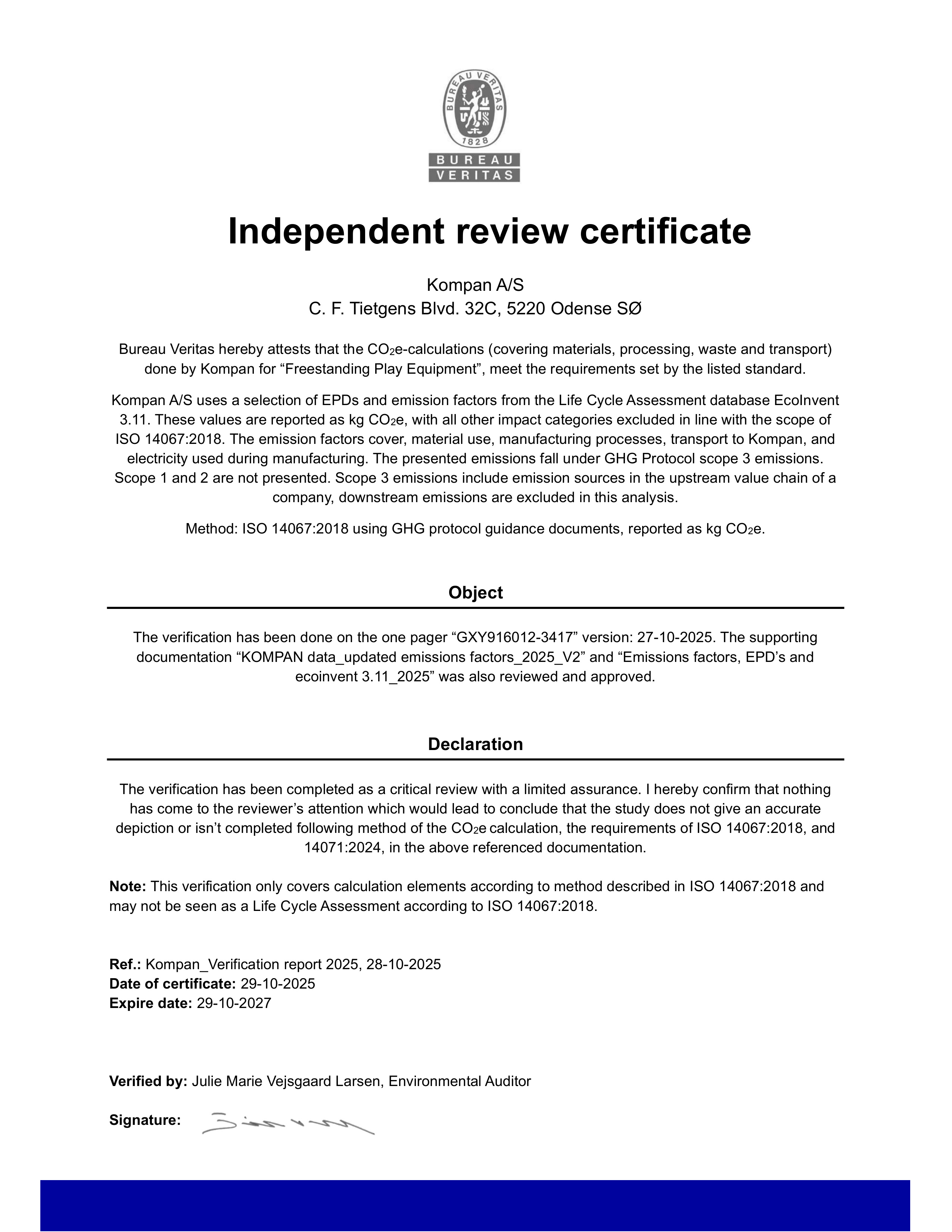
Our product and sustainability data validation help customers make informed sustainable buying choices based on methods validated by Bureau Veritas.
KPL103-0411
97.65
Total CO₂ emission (kg CO₂e)
3.95
CO₂e/kg (kg CO₂e/kg)
44.55%
Recycled materials
The overall framework applied for these factors is the Environmental Product Declaration (EPD), which quantifies "environmental information on the life cycle of a product and enable comparisons between products fulfilling the same function" (ISO, 2006). This follows the structure and applies a Life-Cycle Assessment approach to the entire Product stage from raw material through manufacturing (A1-A3).